
For many manufacturers and logistics managers, the real question is not whether pallet wrapping is necessary, but which method actually fits their operation. Stretch wrap has been used for decades and remains widely adopted, while stretch hood film is increasingly promoted as a more advanced alternative. Yet choosing between them is rarely straightforward.
This article does not aim to prove that one solution is universally better than the other. Instead, it focuses on how stretch hood film and stretch wrap behave under real operating conditions, helping decision-makers identify which option solves their specific problems rather than adding new ones.
Why This Comparison Matters More Than Ever
Packaging failures are rarely caused by a single weak point. They result from a combination of load characteristics, transport conditions, handling frequency, and environmental exposure. Many companies continue using stretch wrap simply because it is familiar, only to face recurring issues such as load instability, weather damage, or inconsistent wrapping quality.
Stretch hood film was developed to address some of these limitations, particularly in automated and high-volume environments. However, it also introduces new considerations, including equipment requirements and application discipline.
Understanding where each solution performs well—and where it does not—is essential for making an informed decision.
How Stretch Wrap Works in Practice
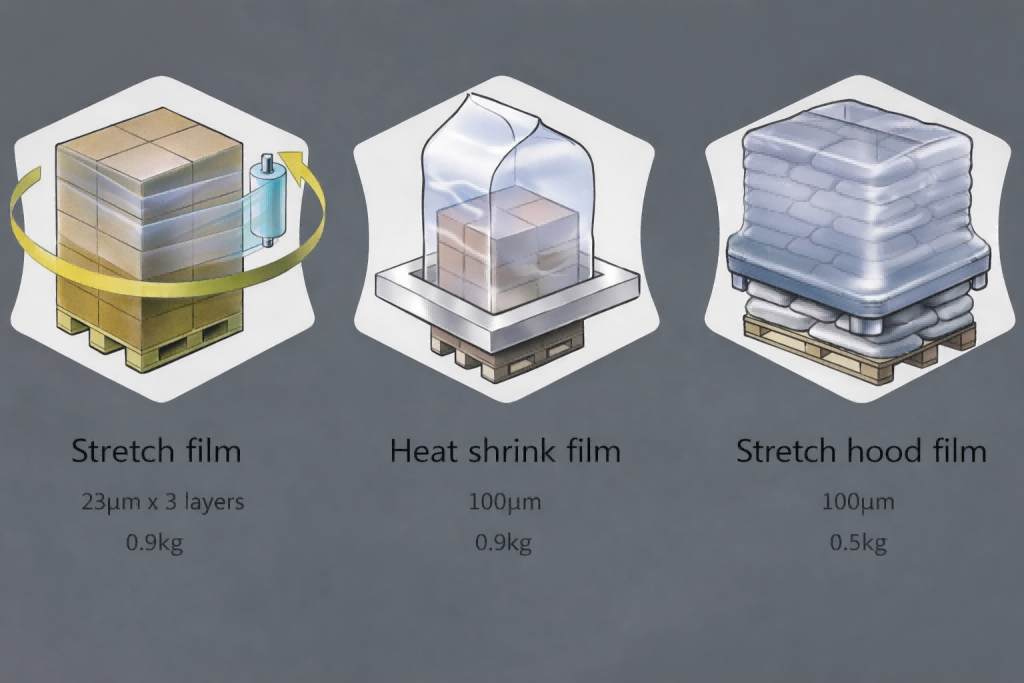
Stretch wrap is applied horizontally around a pallet, usually in multiple layers. Containment force is created by stretching the film as it wraps, relying on friction between layers and compression against the load.
This method offers flexibility. It works well for mixed pallets, irregular shapes, and low-volume operations where manual or semi-automatic wrapping is preferred. Adjustments can be made on the spot by operators, which is often valued in dynamic warehouse environments.
However, this flexibility also introduces variability. Wrapping quality depends heavily on machine settings, operator behavior, and film consistency. Two pallets wrapped on the same day may perform very differently during transport.
Another key limitation is exposure. The top of the pallet is usually left uncovered, making products vulnerable to rain, dust, and condensation.
How Stretch Hood Film Changes the Packaging Logic
Stretch hood film approaches pallet packaging from a system-level perspective rather than a wrapping technique.
The film is applied from the top down as a single tubular hood. It is mechanically stretched, placed over the pallet, and released to contract uniformly around the load. This creates consistent containment force across all sides and fully covers the pallet top.
The result is not just a different wrapping method, but a different packaging outcome. Load stability becomes predictable. Environmental protection becomes integral rather than optional. Packaging quality becomes repeatable rather than operator-dependent.
For operations where variability is a cost driver, this difference is significant.
Load Stability: Layered Tension vs Uniform Containment
Stretch wrap stabilizes loads through layered tension. Each wrap adds friction and compression, but tension is rarely uniform. Weak points often develop around corners, edges, or settling areas within the load.
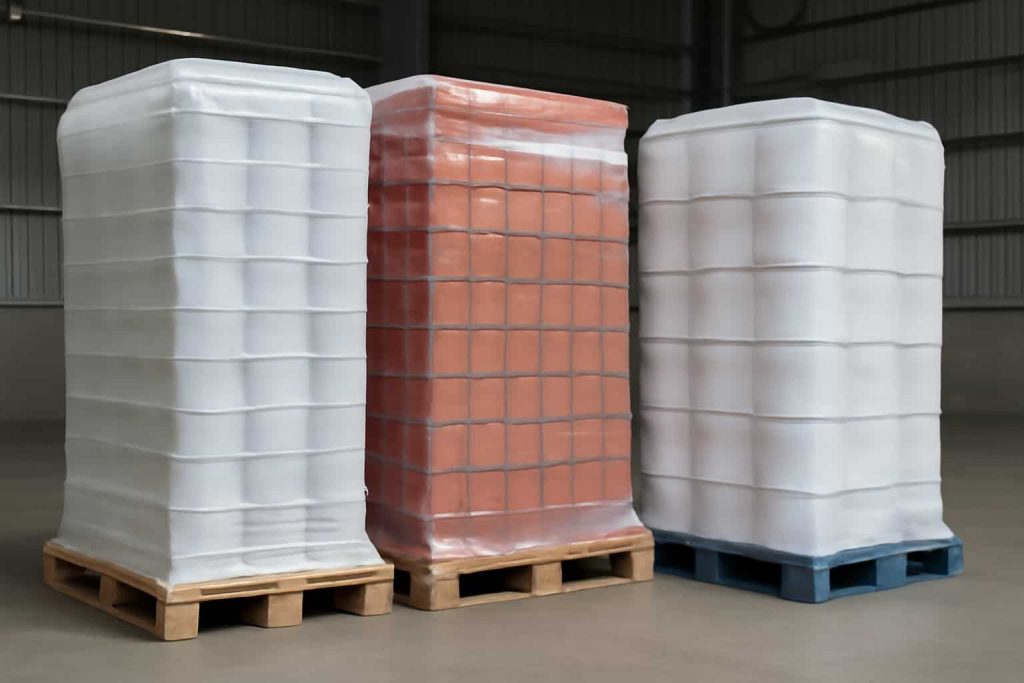
Stretch hood film stabilizes loads as a single unit. The elastic recovery of the film applies even pressure across the entire pallet, adapting to load movement during transport rather than resisting it unevenly.
This distinction matters most for heavy loads, stacked bags, and products that shift under vibration. In such cases, stretch hood film typically delivers more reliable results with less material.
Environmental Protection: Partial Coverage vs Full Enclosure
Stretch wrap offers limited environmental protection. While it shields the sides of a pallet, the top remains exposed unless additional materials are used. This is often acceptable for indoor storage but becomes risky during outdoor handling or export shipping.
Stretch hood film fully encloses the pallet, providing protection against rain, dust, and UV exposure. It also reduces air exchange around the load, which helps mitigate condensation caused by temperature fluctuations.
For companies shipping through ports or storing goods outdoors, this difference alone can justify the transition.
Automation and Consistency in High-Volume Operations
Stretch wrap is compatible with a wide range of manual, semi-automatic, and automatic systems. This makes it accessible, but consistency remains a challenge at scale.
Stretch hood film is designed specifically for automated packaging lines. When properly matched with equipment, it delivers uniform results pallet after pallet, shift after shift.
However, this consistency depends on film quality. Inconsistent thickness, unstable stretch behavior, or poor surface characteristics can lead to machine downtime. This is where experienced manufacturers such as Sinyar Pack differentiate themselves—by treating film performance as part of the system, not just a material specification.
Material Usage and Cost Reality
At first glance, stretch wrap often appears cheaper because it requires minimal equipment investment. Stretch hood systems involve higher upfront costs, which can discourage adoption.
Yet cost evaluation should extend beyond film price and equipment alone.
Stretch hood film often reduces film consumption per pallet due to optimized stretching and uniform containment. It also reduces labor involvement, rewrapping, and damage-related losses.
For high-volume operations, total packaging cost over time frequently favors stretch hood film, despite higher initial investment.
Flexibility vs Process Discipline
Stretch wrap offers flexibility. Operators can adjust wrapping patterns, tension, and coverage as needed. This is valuable in environments with frequent SKU changes or irregular pallets.
Stretch hood film requires discipline. Load dimensions, pallet quality, and process parameters must be controlled. When these conditions are met, performance is highly predictable. When they are not, issues arise quickly.
The choice between the two often reflects how standardized an operation already is.

Sustainability Considerations Beyond Plastic Reduction
Sustainability is not only about reducing plastic usage; it is about reducing waste across the supply chain.
Stretch wrap can generate excess material usage due to overlapping layers and rewrapping. Stretch hood film focuses on material efficiency and damage reduction.
Both solutions use recyclable polyethylene materials, but stretch hood film often delivers better sustainability outcomes when evaluated across transport efficiency, damage reduction, and material optimization.
Choosing Based on Operational Reality, Not Trend
Stretch hood film is not a trend replacement for stretch wrap. It is a targeted solution for specific challenges.
If your operation values flexibility, low upfront cost, and manual adaptability, stretch wrap remains a valid choice.
If your operation struggles with load instability, weather exposure, inconsistent packaging quality, or automation inefficiency, stretch hood film deserves serious consideration.
Manufacturers like Sinyar Pack work closely with customers to assess these conditions before recommending solutions, ensuring that material choice aligns with operational reality rather than marketing claims.
Final Thoughts: Making the Right Choice for Your Business
The decision between stretch hood film and stretch wrap should be driven by real-world performance, not habit or assumption.
Stretch wrap continues to serve many operations effectively. Stretch hood film, however, provides a clear advantage where stability, protection, and consistency are critical.
For companies facing recurring pallet failures or preparing for automated logistics, understanding this distinction is the first step toward a more reliable packaging strategy.