
In palletized logistics, packaging failure is rarely caused by a lack of film. Instead, it is caused by choosing the wrong packaging method for the actual transport conditions. Many manufacturers only realize this after experiencing repeated load instability, weather-related damage, or unexpected packaging costs.
Stretch hood film is not a universal solution for every pallet. However, for companies facing specific challenges—heavy loads, outdoor storage, long-distance transport, or automated packaging lines—it can solve problems that traditional stretch wrap simply cannot. This article focuses on those real-world challenges, explaining how stretch hood film works, when it makes sense, and how experienced suppliers such as Sinyar Pack approach it differently from generic film providers.
Why Traditional Pallet Wrapping Often Fails in Real Operations
Most pallet packaging problems do not show up on the first shipment. They appear after pallets are exposed to vibration, humidity, stacking pressure, or repeated handling.
Traditional stretch wrap is applied horizontally, layer by layer. While it can look secure at first, it often fails under three conditions:
First, the top of the pallet remains exposed. Rain, dust, and condensation can enter during outdoor storage or port handling.
Second, containment force depends heavily on wrapping patterns and machine settings, which leads to inconsistency between pallets.
Third, multiple film layers increase material usage and labor time without guaranteeing better load stability.
These issues become critical when products are heavy, sensitive to moisture, or shipped over long distances.
What Stretch Hood Film Actually Changes
Stretch hood film approaches pallet packaging from a completely different direction—literally and technically.
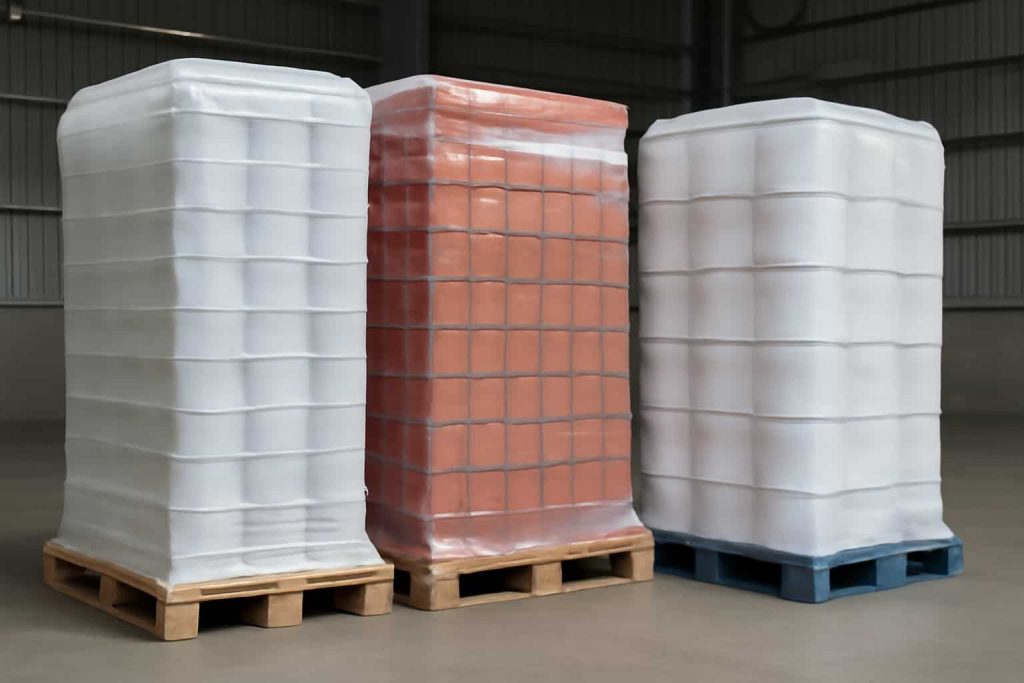
Instead of wrapping around the pallet, stretch hood film is applied from the top down as a single tubular hood. The film is mechanically stretched, positioned over the pallet, and then released. As it contracts, it applies uniform pressure across the entire load while fully covering the top surface.
This changes three key things at once:
• Load stability becomes uniform instead of layered
• Environmental protection becomes complete instead of partial
• Packaging results become repeatable instead of operator-dependent
For companies dealing with frequent pallet failures, these differences are not theoretical—they directly impact damage rates and logistics costs.

Understanding When Stretch Hood Film Makes Sense
Stretch hood film is not meant to replace all stretch wrapping. It is most effective when specific conditions exist.
It makes sense when loads are heavy or tall and require strong vertical containment.
It makes sense when pallets are stored outdoors or shipped through ports where weather exposure is unavoidable.
It makes sense when packaging operations are automated and consistency matters more than manual flexibility.
Companies that ship cement bags, chemicals, animal feed, construction materials, or bottled beverages often fall into this category.
If your primary concern is low-volume manual wrapping, stretch hood film may not be the right solution. But if your concern is load failure after shipping thousands of pallets, it often is.
How Stretch Hood Film Solves Load Stability Problems
Load instability is rarely caused by weak film. It is caused by uneven force.
Stretch hood film solves this by applying tension evenly on all sides at the same time. The elastic recovery of the film absorbs vibration during transport rather than transferring it directly to the load.
This is particularly important for:
• Pallets with stacked bags
• Loads with uneven surfaces
• Products that settle during transport
Instead of tightening some areas more than others, stretch hood film stabilizes the pallet as a single unit.
Environmental Protection Is Not Just About Rain
Many companies think about moisture only in terms of rain. In reality, condensation is often the bigger problem.
Temperature changes during transport cause moisture to form inside partially wrapped pallets. Stretch hood film reduces air exchange around the load, helping stabilize internal conditions.
This is why stretch hood film is commonly chosen for:
• Export shipments
• Long-term warehouse storage
• Climate-variable transport routes
Optional UV-stabilized formulations further protect products stored outdoors for extended periods.
Material Structure Matters More Than Film Thickness
A common misconception is that thicker film always means better protection. In stretch hood film, structure matters more than thickness.
Modern stretch hood film is produced using multi-layer co-extrusion. Each layer has a function:
• Outer layers resist puncture and abrasion
• Inner layers provide stretch and recovery
• Core layers maintain strength and consistency
This allows thinner films to perform better than older, thicker materials. When film structure is poorly designed, even thick film can fail under stress.
Manufacturers like Sinyar Pack focus heavily on layer balance and consistency, not just total thickness.
Automation Compatibility and Operational Reality
Stretch hood film is designed for automated systems. This brings advantages—but also requirements.
Film width consistency, stretch behavior, and surface friction all affect machine performance. Poor-quality film leads to misfeeds, tearing, and downtime.
This is where supplier experience becomes critical. Stretch hood film must perform not only in the lab but also at full production speed, shift after shift.
Sinyar Pack approaches stretch hood film as part of a system, not just a consumable. Film performance is evaluated based on real machine behavior, not just material specifications.

Cost Control Beyond Film Price
Stretch hood film is sometimes perceived as a higher-cost option because of equipment investment. This view ignores total cost of ownership.
When evaluating real costs, companies should consider:
• Reduced film consumption per pallet
• Lower labor involvement
• Fewer damaged products
• Reduced rewrapping and claims
In high-volume operations, these savings often outweigh initial equipment costs within a predictable timeframe.
Sustainability Without Compromising Performance
Sustainability in packaging is often misunderstood as simply using less plastic. In practice, it is about reducing waste across the entire supply chain.
Stretch hood film contributes by:
• Lowering material usage per pallet
• Reducing damaged goods and returns
• Improving load efficiency during transport
Most stretch hood films are recyclable polyethylene materials. When designed correctly, sustainability and performance support each other rather than conflict.
Choosing the Right Stretch Hood Film Partner
Stretch hood film performance depends as much on the manufacturer as on the material itself.
A reliable partner understands application conditions, not just product specifications. This includes load type, transport environment, machine compatibility, and long-term operational goals.
Sinyar Pack positions itself not as a generic film supplier, but as a solution-oriented manufacturer focused on consistent performance, technical understanding, and long-term cooperation.
For customers facing recurring pallet failures, environmental damage, or automation challenges, this difference matters.
Stretch Hood Film as a Strategic Packaging Decision
Stretch hood film is not about following a trend. It is about addressing specific operational risks that traditional wrapping methods struggle to control.
For companies that ship heavy, valuable, or weather-sensitive products at scale, stretch hood film offers a practical and proven way to improve stability, protection, and efficiency.
When implemented with the right material design and supplier expertise, it becomes a long-term packaging solution rather than a recurring problem.