
Key Takeaways for Procurement & Packaging Engineers:
Down-gauging to 4.5µm–6µm reduces material consumption by up to 40%, but success depends on puncture resistance, gauge uniformity, and holding force on automated high-speed wrapping lines.
30%+ PCR (Post-Consumer Recycled) content in industrial shrink film enables scope 3 carbon reduction without sacrificing tensile strength or optical clarity through advanced multi-layer co-extrusion technology.
Total Cost of Ownership (TCO): True value lies in zero film-snapping downtime and 100% pallet load integrity, not just the thinnest gauge or lowest initial resin price.
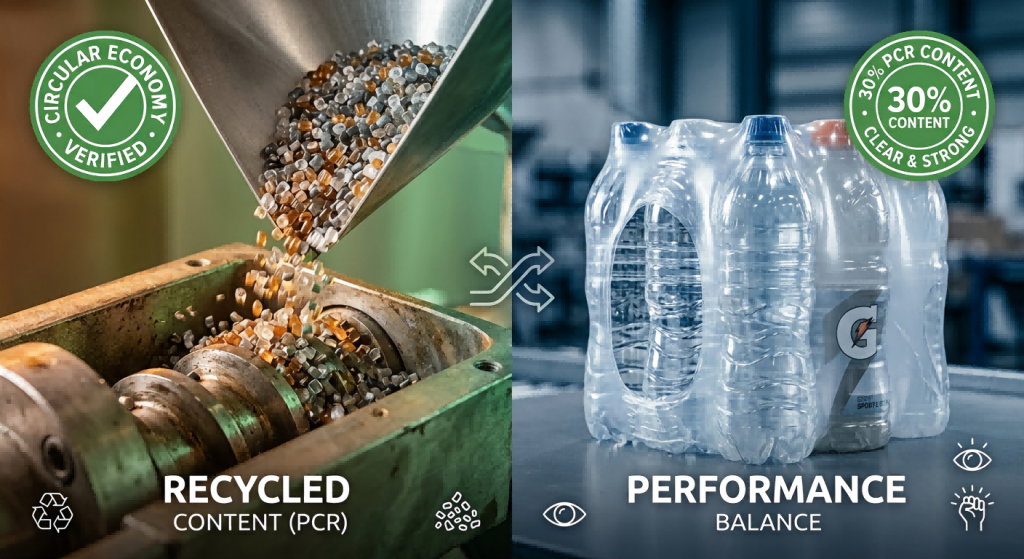
The Paradigm Shift in Industrial Flexible Packaging
For decades, B2B procurement of industrial stretch wrap and heat shrink film revolved around three basic variables: thickness (gauge), roll weight, and unit price per kilogram.
However, leading global film manufacturers and tier-1 converters are sending a definitive signal to the market. High-performance down-gauging (e.g., 6-micron and 4.5-micron ultra-thin stretch films) and circular economy integration (e.g., 30% PCR shrink films) are no longer just optional eco-friendly product lines—they are becoming the baseline standard for material engineering capability.
This transition reflects a fundamental market evolution: Sustainability goals and high-speed operational reliability are now evaluated together.
1. Ultra-Thin Stretch Film: Engineering Beyond Raw Gauge Reduction
Reducing stretch film thickness down to 4.5 or 6 microns is far more complex than adjusting extruder controls. As the gauge thins, manufacturing tolerances become exponentially tighter.
Technical Requirements for High-Performance Ultra-Thin Films:
- Exceptional Gauge Uniformity: Minute variations in film thickness at 5 microns cause weak points, leading to immediate tears under high pre-stretch ratios.
- Superior Puncture & Tear Resistance: Thin films must withstand sharp pallet corners, wooden splinters, and irregular cargo geometries.
- High Retention Force: Thinner film must maintain elastic memory over time to prevent load shifting during long-haul transit.
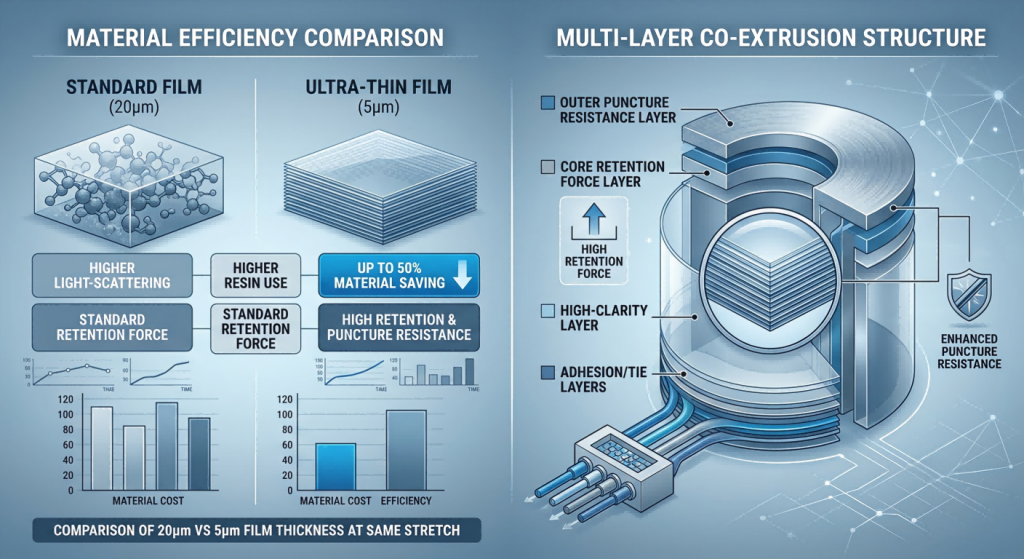
| The Ultra-Thin Down-Gauging Challenge | |
| Traditional 20µm Stretch Film | Ultra-Thin 5µm High-Performance |
| • High resin consumption • Higher freight emissions • Wide processing tolerance | • Up to 50%+ resin savings • Reduced Scope 3 footprint • Requires zero-defect extrusion |
The Buyer’s Dilemma: Will thinner film break on automated lines?
The Reality: Down-gauging fails when treated purely as a cost-cutting tactic without evaluating application parameters. Pushing gauge limits without verifying puncture performance causes film snapping, machine downtime, and increased cargo damage. True cost efficiency is achieved when film yield increases while load containment remains 100% stable.
2. 30% PCR Shrink Film: Overcoming the Performance Trade-Off
As brands work to meet mandatory recycled content targets and reduce carbon intensity, integrating Post-Consumer Recycled (PCR) resin into industrial shrink and stretch packaging has become critical.
How Multi-Layer Co-Extrusion Solves the PCR Challenge
Historically, high PCR content brought concerns regarding film haziness, inconsistent tensile strength, and gel contamination. Modern packaging technology overcomes this through advanced multi-layer co-extrusion:
- Outer Virgin Layers: Provide high clarity, superior heat sealability, and smooth surface finish.
- Core PCR Layer: Encapsulates 30%+ recycled polymers within the inner layers, preserving mechanical strength while maximizing recycled content.
This structure allows operations to lower carbon footprints and meet regional sustainability mandates without sacrificing wrapper speed or bundle security.
3. ESG Compliance as a Benchmark for Vendor Reliability
ESG (Environmental, Social, and Governance) disclosure and technical reports are no longer just corporate PR. In the B2B packaging sector, multinational procurement teams, quality auditors, and brand owners actively use these metrics to assess supplier competence.
When selecting a long-term packaging partner, relying solely on basic spec sheets is no longer sufficient. Leading packaging suppliers differentiate themselves by offering:
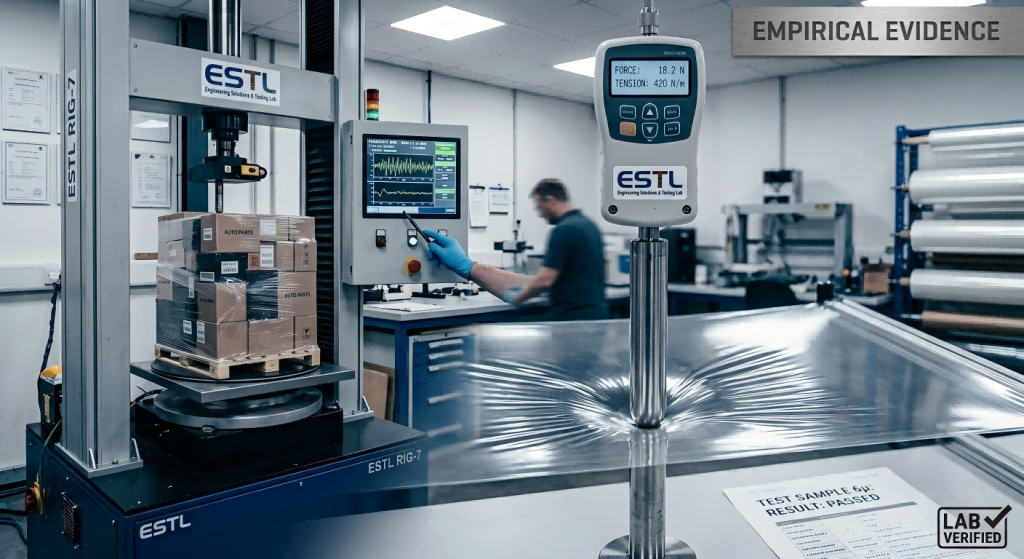
- Empirical Testing Data: Verified puncture resistance, pre-stretch capabilities, and holding force analytics.
- On-Site Application Matching: Tailoring film specs to match specific pallet wrapping machinery, wrapping speeds, and cargo profiles.
- Verifiable PCR Traceability: Transparent documentation backing carbon reduction claims and recycled resin origin.
Frequently Asked Questions (FAQ)
Q1: Can 6-micron or 4.5-micron stretch film be used on high-speed automatic wrappers?
A: Yes, but only if the film utilizes high-grade resin formulations and multi-layer structural design. The wrapping machine’s pre-stretch tension settings must also be properly calibrated to ensure the film operates within its elastic limit.
Q2: Does adding 30% PCR affect the puncture resistance of shrink film?
A: With multi-layer co-extrusion technology, recycled resins are core-layered between virgin polymers. This preserves essential tensile and puncture properties, making 30% PCR film fully functional for heavy-duty industrial bundled packaging.
Q3: How does down-gauging impact total packaging costs?
A: While ultra-thin films may carry a higher price per ton due to resin quality and processing precision, they drastically lower the cost per wrapped pallet by reducing total plastic weight used per unit.
Conclusion: Balancing Efficiency, Performance, and Sustainability
The move toward ultra-thin gauges and recycled content isn’t about chasing extreme low-micron records at the risk of load failure. It is about optimizing material consumption through precise engineering, empirical testing, and reliable delivery.
Whether evaluating 4.5-micron stretch wrap or 30% PCR shrink packaging, success depends on partnering with manufacturers who validate their products through data, application compatibility, and verified quality control.