
For years, the industrial packaging film market was dominated by a simple metric: price per roll. However, a close observation of recent sustainability reports from leading Asian film manufacturers reveals a significant paradigm shift. The introduction of 4.5µm to 6µm ultra-thin stretch films and 30% Post-Consumer Recycled (PCR) shrink films sends a clear signal to the market.
The competition in the flexible packaging industry is no longer just about manufacturing scale. It has evolved into a race for down-gauging, high-speed application stability, and verifiable ESG (Environmental, Social, and Governance) narratives.
For global logistics directors, procurement managers, and packaging engineers, understanding these three interconnected trends is crucial for building a resilient and cost-effective supply chain.
Trend 1: Ultra-Thin Films Are About Engineering, Not Just “Less Plastic”
When suppliers introduce 6µm or even 4.5µm stretch films, buyers naturally ask: “Will it break during wrapping?”
Down-gauging is not achieved by simply turning down the extruder settings. As the film gets thinner, the demand for superior resin quality, precise gauge uniformity, and advanced extrusion technology increases exponentially. A successful ultra-thin stretch film must maintain high puncture resistance and load retention force to secure pallets effectively.
If a buyer’s on-site wrapping equipment, pallet corner sharpness, or operator habits are not aligned with the film’s specifications, excessive down-gauging can lead to frequent film breakages and costly transit damage. Therefore, when a manufacturer promotes ultra-thin film capabilities, they are essentially demonstrating their mastery of polymer science and advanced manufacturing control.
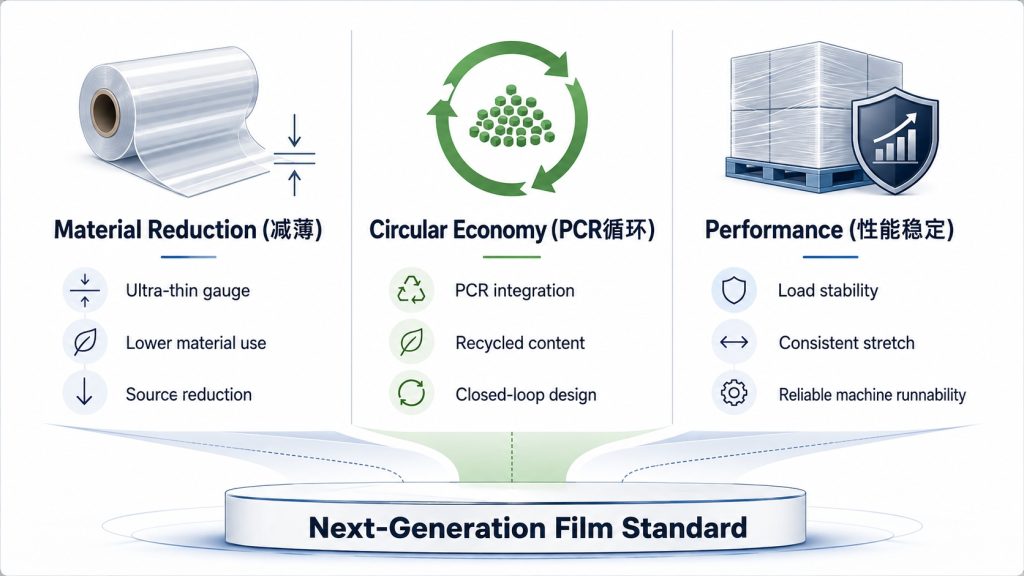
The commercialization of films with 30% or more Post-Consumer Recycled (PCR) content proves that sustainability is moving from marketing brochures to production lines.
The challenge with PCR resins is their inherent batch-to-batch variability. Integrating recycled content into shrink films or stretch wraps without compromising optical clarity, thermal shrinkage rates, or tensile strength requires sophisticated formulation and multi-layer co-extrusion technology. The presence of PCR films in a supplier’s portfolio reassures buyers that their eco-friendly initiatives will not result in operational downgrades.
Trend 3: ESG Reports as a B2B Procurement Window
Many enterprises mistakenly view peer ESG reports merely as corporate image materials. In the B2B packaging sector, however, an ESG report is increasingly serving as a qualification window for supplier capability.
Large multinational buyers, brand compliance departments, and factory auditors scrutinize these reports to identify carbon reduction pathways, PCR application readiness, and lightweighting technologies. Stretch film and shrink film are no longer viewed as isolated consumables; they are integral components of a brand’s overarching “material reduction” and “circular economy” narratives.
Suppliers who only present specification sheets and price lists will struggle to convey their long-term technical accumulation. Those who integrate product performance with ESG goals immediately stand out during the vendor selection process.
The Buyer’s Checklist: Evaluating Next-Generation Films
To confidently adopt these thinner, faster, and greener films, procurement teams should evaluate suppliers beyond basic specifications. A reliable packaging partner should be able to answer three critical questions:
- Does the thin film match our equipment? Require machine tension tests and field application data to ensure the thinner gauge won’t snap on high-speed automated wrappers.
- Will environmental compliance compromise transit safety? Request continuous puncture and retention force test data for PCR films to guarantee load stability during long-haul transport.
- Can the supplier deliver consistently? Verify the supplier’s quality control protocols for managing PCR resin fluctuations and maintaining exact gauge tolerances across multiple orders.
Ultimately, the true value of modern packaging films lies not in the cheapest upfront cost, but in the proven ability to deliver material savings, operational stability, and verifiable environmental compliance.
Would you like me to help you adapt the core insights from this article into a series of short, engaging posts for your LinkedIn profile or Alibaba platform updates to drive more direct B2B inquiries?